
From the outside, a veterinary practice can look like it is doing everything right. The schedule is full. The phones are ringing. The team is moving nonstop. Clients keep coming through the door. So why does ownership still feel heavy? Why does cash still feel tight? Why does payroll feel harder to absorb every year? Why does growth feel more stressful than exciting?
That disconnect is more common than many veterinary practice owners realize. A hospital can be busy, respected, and generating real revenue, yet the owner still feels like the business is harder than it should be. That is because being busy and being financially healthy are not the same thing.
According to the American Veterinary Medical Association, veterinary practice owners across the country are facing financial pressure on their practice, such as:
- rising operating costs,
- staffing shortages, and
- changing client demand patterns.
This disconnect is becoming increasingly common in veterinary medicine. Understanding why it happens is the first step toward fixing it.
You May Also Like: The Veterinary Survival Show (LGA Podcast)
Get the ideas and tools you need to not just survive in this jungle of financial insecurity, HR nightmares, and overall business confusion, but to thrive in veterinary practice management. By combining over 50 years of knowledge and experience with differing opinions and a little humor, they help get the information you need to make the best decisions for you and your veterinary business.

When Busy Doesn’t Mean Profitable
Many owners are working harder than ever, but they are not seeing the financial return they expected. Revenue may look decent on paper, yet cash flow remains tight. Profit margins feel inconsistent. And despite all the effort going into the practice, the numbers never seem to create real breathing room.
That is where frustration sets in.
Veterinary practice owners are not just delivering medicine. They are managing people, making hiring decisions, overseeing overhead, handling client expectations, investing in equipment, and trying to build a business at the same time. It is a constant balancing act, and the financial pressure can build quietly until it starts affecting every major decision.
Veterinary Medicine Has Its Own Financial Reality
This industry operates differently than most others, and that matters. Clients want excellent medicine, advanced diagnostics, and a high level of care. In many cases, they also expect an experience that feels closer to human healthcare than traditional animal care. But in veterinary medicine, the economics are more visible.
There is no large insurance structure absorbing most of the cost and softening the financial conversation. Clients are often making decisions based on what they can pay in real time. That means veterinary teams are trying to deliver quality care while also navigating emotional, sometimes difficult, conversations about money.
On the other side of that conversation is the practice owner, who is carrying the actual cost of delivering that care. Equipment is expensive. Buildouts are expensive. Diagnostics are expensive. Staffing is expensive. Every improvement to the standard of care usually comes with a higher cost structure behind it.
If the business side is not being managed with discipline and insight, the practice can look successful while the owner feels financially boxed in.
The Hidden Financial Blind Spots in Veterinary Practices
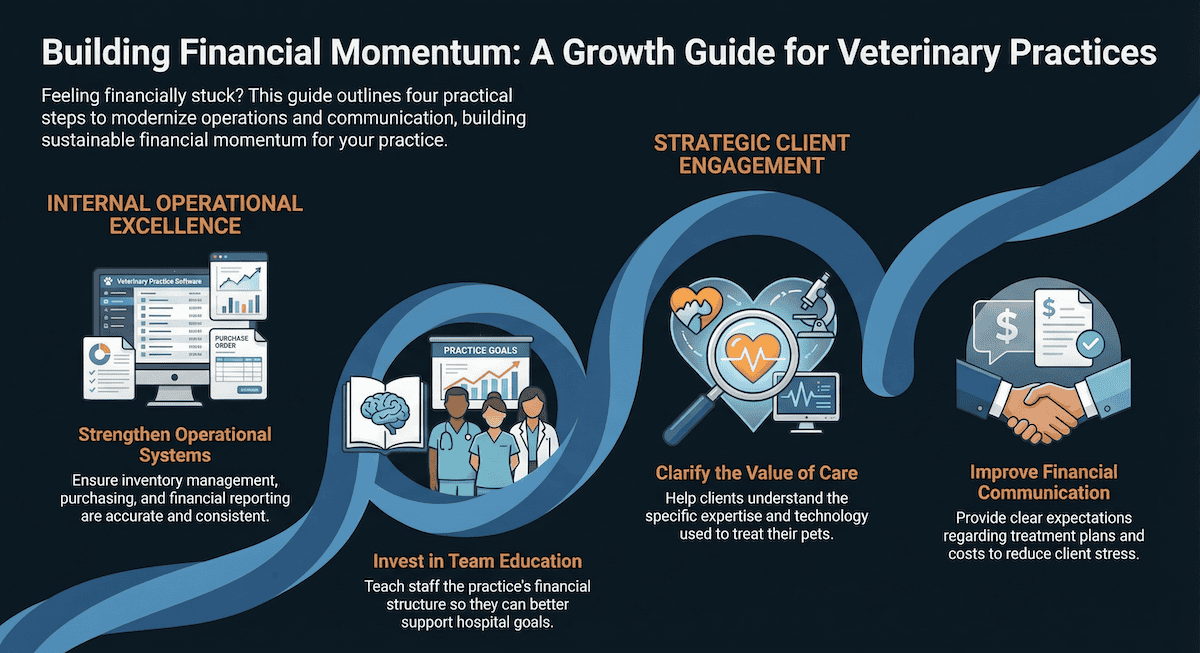
Not every financial challenge comes from outside the practice. Often, the issue isn’t revenue at all, but how internal systems quietly affect margins. Inventory management is one of the most common examples. Veterinary hospitals carry hundreds or even thousands of medications, vaccines, diagnostic supplies, and treatment products. These items represent a significant portion of operating expenses.
In theory, practice management systems track all of this. In reality, the numbers are not always perfect.
- Busy technicians are multitasking.
- Products may be entered incorrectly.
- Units may be recorded differently from one order to the next.
- Some items may appear in the system with no cost attached, while others may show negative quantities.
These small inconsistencies may seem harmless, but they can distort financial reporting over time. For a practice owner trying to understand why profits feel tight, these operational blind spots can make the picture even more confusing.
Data errors here and there can quietly grow into thousands of dollars in lost margin.
The Rising Cost of Staffing
Labor is another major pressure point, and it is not going away. Veterinary medicine is experiencing many of the same workforce challenges affecting other healthcare fields. Practices across the country are competing for veterinarians, technicians, and experienced support staff.
When a practice cannot hire fast enough, it often relies on relief doctors or temporary staffing to keep the schedule moving. That may solve an immediate operational problem, but it usually comes at a premium. At the same time, if the hospital cannot support demand because of staffing shortages, clients do not always wait. They go elsewhere.
At the same time, veterinarian compensation has increased significantly over the past decade. Higher pay is not necessarily a problem. But rising labor costs still affect a practice’s financial structure.
And when staffing shortages reduce appointment availability, the problem compounds. If clients cannot schedule a visit for their pet when it needs care, they may go elsewhere. Over time, that lost volume can slowly erode revenue.
When Growth Becomes Complicated
When practice owners feel financial pressure, the most common advice they hear is simple: Grow. See more patients. Hire another veterinarian. Expand the hospital. Open another location.
But growth is not always the right answer in every situation.
Some veterinary practices operate in older buildings or historic properties where expansion is difficult. Others are limited by parking, zoning rules, or facility layout. Even when expansion is possible, it introduces new risks, like:
- increase stress,
- administrative complexity, and
- financial exposure.
Growth sounds exciting, but in veterinary medicine it is expensive, operationally complex, and often slower to pay off than expected. A new veterinarian does not just mean a salary. It means support staff, exam room capacity, equipment, onboarding, systems, and time to build a caseload. A larger footprint brings financing, workflow changes, and overhead. A second location creates a completely different management challenge.
Some owners are also limited by their physical space. Older buildings, historic locations, parking issues, and zoning restrictions can all make expansion unrealistic. That is why the better question is not always, “How do we get bigger?”
Sometimes the better question is, “What kind of practice are we actually trying to build?” That is a strategic question. It deserves better than generic business advice.
Growth should be a strategic decision, not an automatic one.
Why Financial Communication Matters
Another challenge that often goes unnoticed is how financial conversations happen inside the hospital.
In many hospitals, treatment plans and costs are discussed quickly, under pressure, and without enough structure. The team is trying to move efficiently, the client is emotional, and everyone is doing their best in the moment. But when there is no clear process, confusion increases. That confusion has a financial cost.
Practices that manage these conversations well tend to be more intentional. They explain treatment recommendations clearly. They set expectations earlier. They help clients understand what is urgent, what is optional, and what the financial implications are before the conversation becomes reactive. That improves trust. It improves decision-making. It improves collections. And it puts the hospital in a stronger position to support both patient care and financial performance. This is not just a communication issue. It is a business issue.
If You Feel Stuck, There Is Usually a Reason
If your practice is busy but the numbers still feel tight, that feeling should not be dismissed. It may be pricing. It may be inventory controls. It may be labor structure. It may be reporting gaps. It may be that your systems are no longer strong enough for the size and complexity of the practice you are running today.
Whatever the cause, veterinary practice owners need more than generic advice. They need CPAs and advisors who understand the veterinary industry, how practices actually operate, where margins get lost, how growth decisions play out, and what owners are up against every day. That kind of guidance is different, and it matters.
At LGA, we work with veterinary practice owners to identify blind spots, improve financial visibility, and build strategies that support stronger profitability and smarter long-term decisions.
Want to have a discussion? Contact me today.


