
Imagine a nonprofit board or leadership meeting. Financial reports are handed out. Within minutes, eyes glaze over. Some participants scan for familiar line items, others flip pages looking for a bottom line, and a few disengage, not from lack of interest, but from uncertainty about what the information is actually telling them.
This reaction is rarely about incompetence or indifference. Board members, executive directors, and senior leaders care deeply about the mission and take their responsibilities seriously. Yet too often, they are asked to make strategic, operational, and fiduciary decisions using financial reports that were designed primarily for accounting completeness and accuracy, not decision‑making.

When this happens, the issue is usually not the accuracy of the numbers. It’s that financial reporting stops short of explaining what the numbers mean, why they changed, and what leadership and the board should be paying attention to next. Many organizations distribute financial statements monthly or quarterly. What’s missing is context, the story behind the numbers that connects financial performance to operations, mission delivery, sustainability, and risk.
Leadership and boards don’t just need more information. They need clarity and interpretation (Enjoying the article so far? You may also like our Nonprofit Financial Stability Series).
Give Them the Story, Not Just the Spreadsheet
Financial reporting plays a dual role in a healthy nonprofit:
- Management and leadership use it to run the organization day‑to‑day and make informed operational decisions.
- Boards rely on it to provide oversight, assess risk, and ensure long‑term sustainability and mission alignment.
Both groups benefit from the same underlying data, but only when it is translated into a clear, usable narrative. This is where an executive summary or financial narrative becomes essential. A strong narrative turns accounting data into a decision‑ready story for non‑financial readers. It helps leadership teams and boards understand not just what happened, but why it happened, whether it matters, and what trade‑offs or decisions it may require.
At a minimum, that narrative should help leadership and the board answer three fundamental questions:
- Why do actual results differ from budget?
- Do those variances reflect temporary timing issues or underlying operational trends?
- How does financial performance support, or constrain, the organization’s ability to carry out its mission?
These questions are rarely answered by reviewing individual line‑item variances in isolation. Instead, they require a higher‑level view, one that explains liquidity, sustainability, risk exposure, and direction over time. The objective is not to oversimplify the numbers, but to interpret them so leadership can manage proactively and boards can govern confidently.
What an Effective Leadership and Board Dashboard Should Answer
The most effective financial dashboards serve both management and the board by focusing attention on what matters most. Rather than overwhelming users with detail, well‑designed dashboards consistently answer four core questions:
- Are we financially stable right now?
- Is our operating and funding model working?
- Where are we exposed to financial risk?
- Are key trends improving or deteriorating over time?
For management, these questions inform operational decisions and resource allocation. For boards, they support oversight, risk monitoring, and strategic discussion. Strong dashboards draw directly from the financial statements but elevate the information to a level that supports leadership and governance. In many organizations, they also incorporate operational data, such as program activity, staffing levels, or fundraising performance, to provide a fuller picture of organizational health.
Key Metrics That Support Oversight and Management
Assessing Current Stability
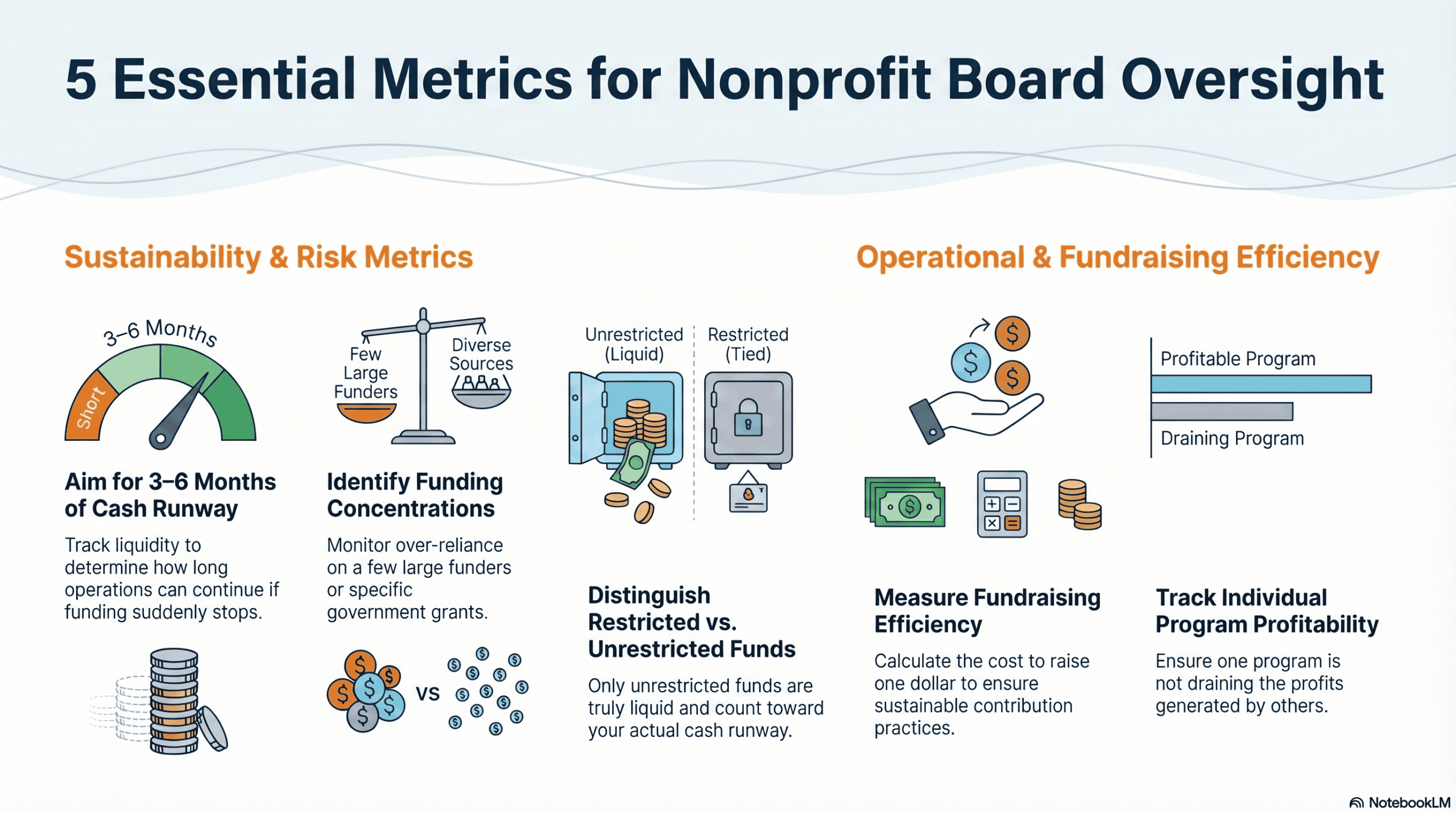
Cash Runway and Liquidity: How long can the organization continue operating if funding is delayed or disrupted? This metric forces an important distinction between total cash and usable cash. Donor‑restricted funds may inflate cash balances but do not provide operational flexibility. For leadership teams, this informs near‑term decision‑making. For boards, it frames discussions about resilience and downside risk. Expressing liquidity in terms of months of unrestricted cash, often with a three‑ to six‑month benchmark, helps both groups assess short‑term stability realistically.
Evaluating the Sustainability of the Model
Program‑Level Financial Performance: For organizations that operate multiple programs, leadership and boards need visibility into which activities generate surpluses and which generate losses and require ongoing subsidy. Without this insight, profitable programs may mask underperforming ones, leading to gradual erosion of overall financial health and sustainability. This analysis is not about eliminating mission‑critical programs. It’s about making informed, proactive, intentional decisions and understanding the true cost of impact.
Fundraising Efficiency: How much does it cost to raise one dollar of contribution revenue? For management, this informs strategic fundraising decisions. For boards, persistent inefficiency can signal donor fatigue, overreliance on events, or structural challenges in the fundraising model that warrant strategic discussion.
Understanding Risk and Vulnerability
Funding Concentrations and Revenue Mix: Leadership teams need to understand how predictable their revenue is in order to plan effectively. Boards need the same information to assess risk. Heavy reliance on a small number of donors, annual renewals, or one‑time funding sources increases exposure, especially when staffing or program expansion decisions depend on uncertain future revenue.
Fixed Cost Coverage: This metric highlights operating leverage. Organizations with high fixed costs, such as staffing, facilities, or long‑term contracts, have less flexibility when revenue declines. Understanding how well those costs are supported by reliable revenue helps management plan responsibly and allows boards to assess downside risk more clearly.
Monitoring Direction and Early Warning Signals
Trends and Predictability: Single‑period results rarely tell the full story. Both leadership and boards should focus on trends over time. Improving margins, declining liquidity, or consistent forecasting inaccuracies often matter far more than any one variance. Trend‑based indicators help organizations distinguish noise from signals and respond appropriately.
Monitor Proactively – Not in Crisis Mode
When financial reporting lacks clarity, the greatest risk is delayed awareness. Management may not escalate concerns early enough, and boards may not recognize emerging issues until they become urgent.
Regular, focused monitoring of key indicators allows leadership teams to manage proactively and boards to fulfill their oversight role effectively. Together, they can determine whether deviations are temporary or signs of deeper structural challenges, and provide time and space to pivot and act long before the organization enters crisis mode.
Suggested monitoring cadence:
- Financially stable organizations: Monthly or quarterly review
- Smaller or less stable organizations: Monthly review
- Organizations under financial stress: Weekly or bi‑weekly monitoring until conditions stabilize
A Practical Note on AI, Tools, and Expertise
Technology, including AI, can be extremely helpful for organizing data, calculating ratios, and producing reports faster. However, tools do not replace judgment. Financial metrics still require interpretation, context, and an understanding of nonprofit operations.
In many organizations, bookkeeping and transactional accounting are handled internally or outsourced. These functions are essential, but they often stop short of helping answer the strategic questions leadership and boards actually have. The greatest value comes when financial reporting bridges the gap between what happened and what it means for decisions going forward.
Ready to Tell a Better Financial Story?
Effective nonprofit financial reporting supports strong management and effective governance. When leadership teams and boards share a clear, consistent understanding of the organization’s financial story, they are far better equipped to make proactive, mission‑aligned decisions.
If your organization is ready to move beyond surface‑level reporting and toward informed leadership and oversight, LGA is here to help. Our focus is on delivering clarity, context, and insight, so nonprofit leaders and boards alike can concentrate on impact (See our case study).


